
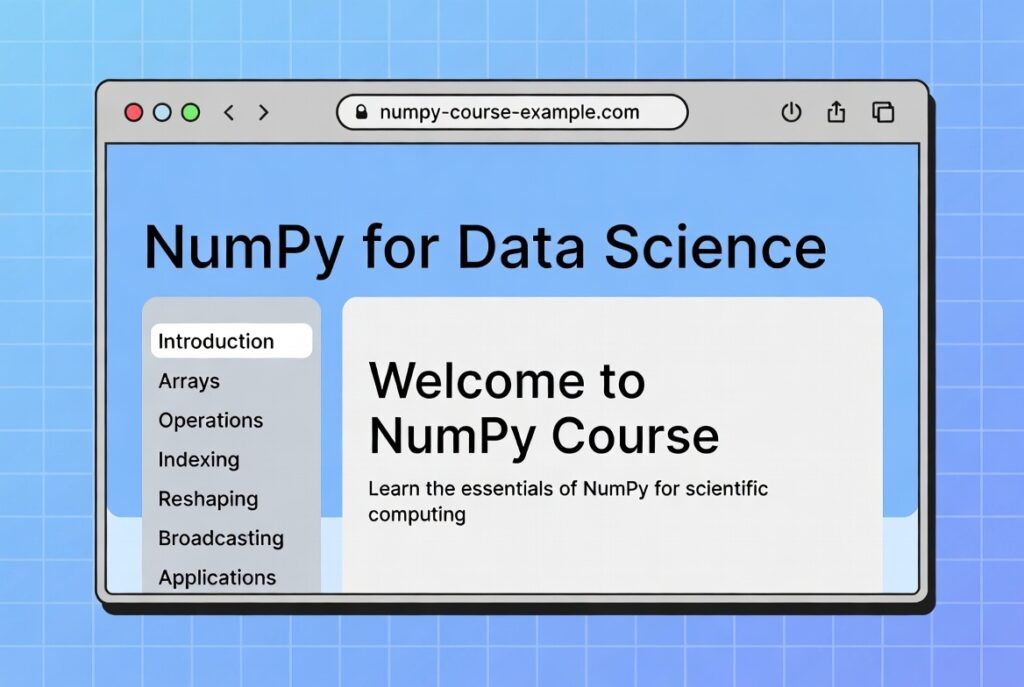
NUMPY course introduction
What is NUMPY?
NUMPY is a popular Python library for data. It helps us work with numbers and arrays easily. Moreover, it makes calculations fast and simple. You can store large data in arrays, not lists. Also, NUMPY is the base for many other libraries.
Why Learn NUMPY:
First, it improves your coding speed and efficiency. Next, it is useful in data science and machine learning. Also, it makes math operations easy on big data. With NUMPY, you can handle arrays and matrices quickly.
Core Features of NUMPY:
NUMPY provides fast array operations and indexing. In addition, it has built-in math functions for arrays. You can perform statistics, sums, and reshaping easily. Moreover, it works with multi-dimensional arrays too.
Why Learn NUMPY?
Boosts Data Skills:
NUMPY helps you handle large data easily. Moreover, it makes calculations faster than normal Python. You can work with arrays, not slow lists. Also, it improves your coding logic and skills. Thus, it is essential for data science beginners.
Supports Machine Learning:
NUMPY is the base for ML like Pandas and TensorFlow. In addition, it allows fast math operations for models. You can handle arrays, matrices, and big datasets efficiently. Also, it helps prepare data for ML projects.
Saves Time and Effort:
With NUMPY, coding becomes shorter and simpler. It reduces long loops for calculations automatically. Moreover, it works with multi-dimensional arrays easily. You can complete tasks faster and more efficiently. Finally, it makes Python projects more professional.
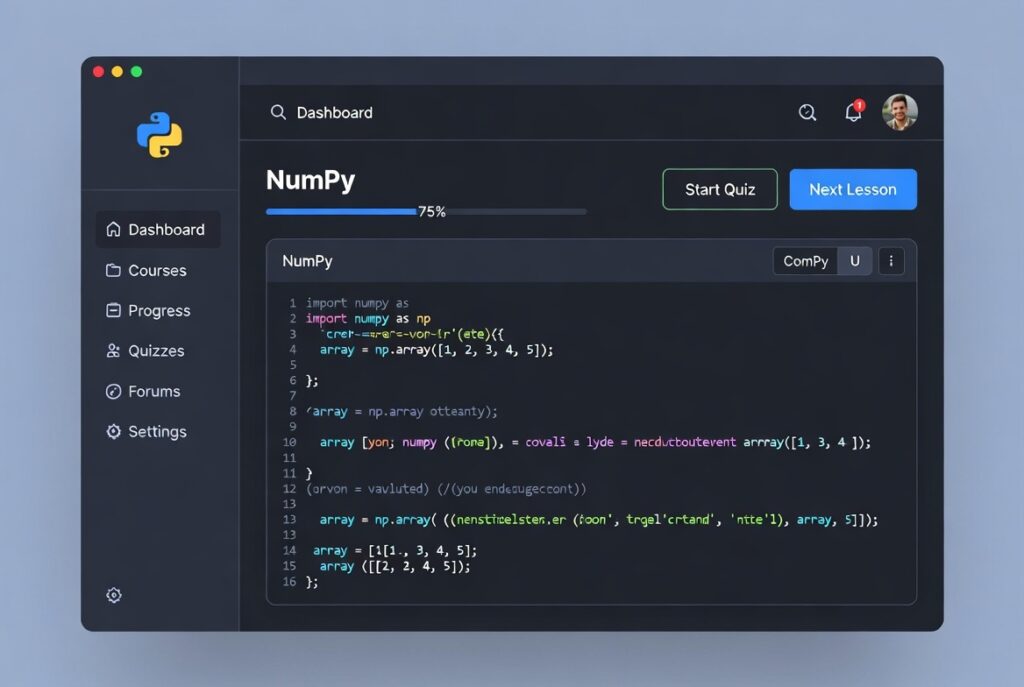
How to Learn NUMPY?
Start with Basics:
First, install NUMPY using pip in Python. Next, import it using import numpy as np. Then, learn to create arrays and use simple functions. Also, understand array indexing and slicing clearly. After that, practice small examples daily for mastery.
Practice with Functions:
Learn built-in NUMPY functions like sum(), mean(), and reshape(). Moreover, try operations on arrays and matrices. Use random number generation and statistical functions too. Also, apply operations in mini-projects or exercises. This practice builds confidence and coding speed.
Apply in Real Projects:
Next, use NUMPY in data analysis and visualization tasks. It works well with Pandas, Matplotlib, and Seaborn. Also, try ML preprocessing with arrays and matrices. Experiment with real datasets to see results clearly.