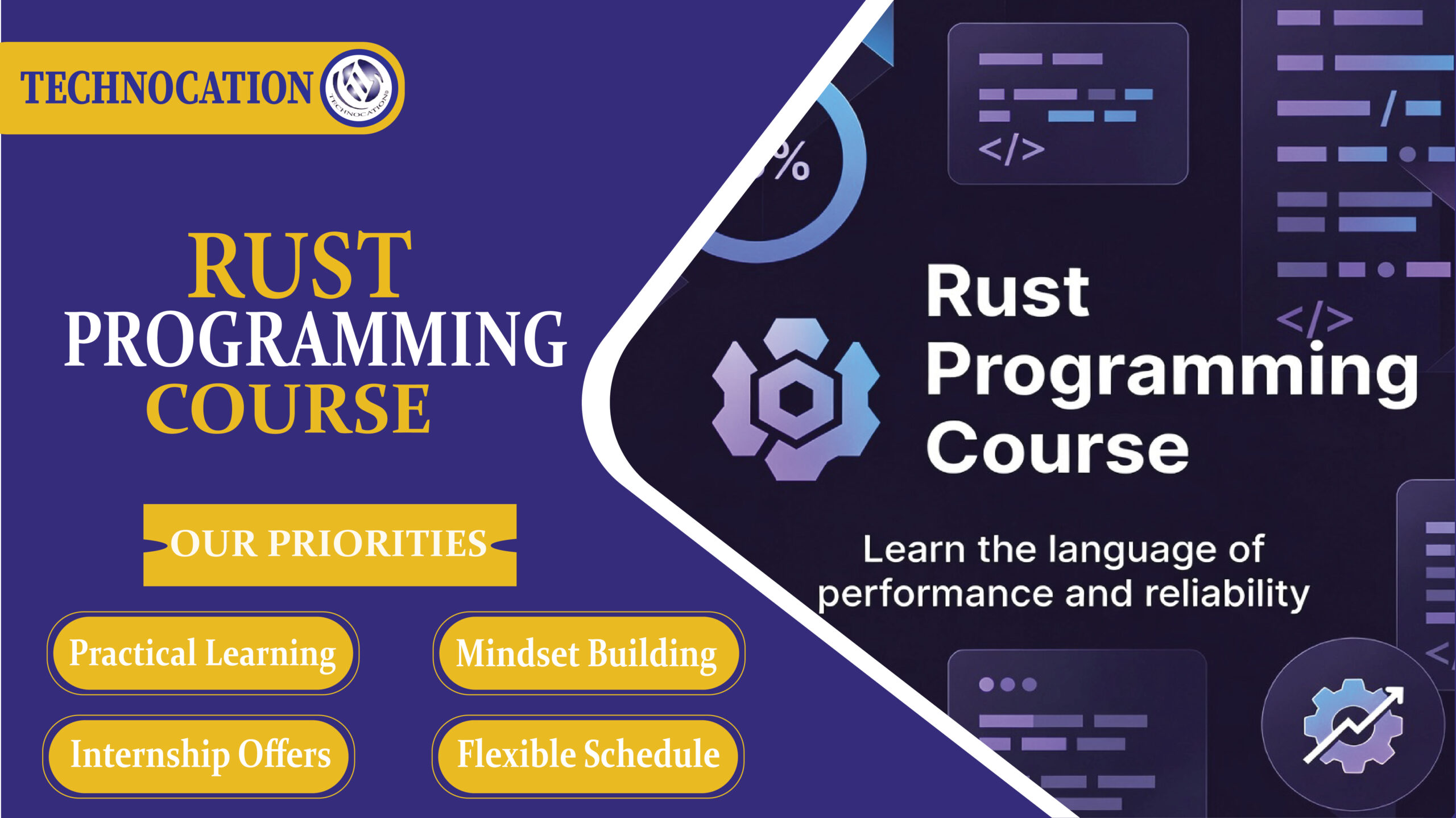
| Course Name | Duration | Classes | Total Fee | Mode of Training | Class Timing |
|---|---|---|---|---|---|
|
Rust Programming
Course |
3 Months |
60 |
36,000 PKR |
Online & Face-to-Face |
To be decided mutually with students |
Rust Programming Training Certification Course Outline
First, we learn Rust basics and simple syntax step by step. Then, we write safe and fast programs using memory control. Next, we build real projects and practice problem solving daily. Finally, we create strong apps and prepare for developer jobs confidently.
Module 1: Introduction to Rust
First, understand what Rust is and why developers prefer it.
Next, install Rust using rustup and set environment.
Then, run your first program using cargo build.
Finally, read basic syntax and project structure clearly.
Module 2: Variables and Data Types
First, declare variables using let keyword simply.
Next, use mut to change values safely.
Then, explore integers, floats, booleans, and characters.
Finally, practice small examples to strengthen understanding.
Module 3: Control Flow
First, use if and else for decisions.
Next, apply match for multiple pattern checks.
Then, create loops using loop, while, and for.
Finally, combine conditions to control program flow clearly.
Module 4: Functions and Modules
First, define functions using fn keyword properly.
Next, pass parameters and return values correctly.
Then, organize code into modules for clarity.
Finally, reuse functions to keep programs clean.
Module 5: Ownership and Borrowing
First, understand ownership rules for memory safety.
Next, move values between variables carefully.
Then, borrow data using references safely.
Finally, avoid dangling pointers through Rust checks.
Module 6: Structs and Enums
First, create structs to store related data.
Next, define enums for multiple possible states.
Then, implement methods using impl blocks.
Finally, model real problems using custom types.
Module 7: Collections
First, use vectors to store dynamic lists.
Next, apply strings for text handling.
Then, use hash maps for key value storage.
Finally, iterate collections using loops efficiently.
Module 8: Error Handling
First, handle errors using Result type properly.
Next, use Option for possible missing values.
Then, apply match to manage failures gracefully.
Finally, write safe code without unexpected crashes.
Module 9: File Handling and I/O
First, open files using Rust standard library.
Next, read and write data securely.
Then, process user input from terminal.
Finally, handle errors during file operations carefully.
Module 10: Concurrency
First, create threads to run tasks parallelly.
Next, share data using channels safely.
Then, use mutex for controlled access.
Finally, build fast programs with safe concurrency.
Module 11: Building Projects with Cargo
First, manage projects using cargo commands daily.
Next, add dependencies through Cargo.toml easily.
Then, test code using cargo test regularly.
Finally, build and release optimized applications professionally.
Module 12: Certification and Final Assessment
First, review all Rust concepts and practice exercises.
Next, complete a real world coding project.
Then, pass the final assessment confidently.
Finally, receive your Rust Programming Certification successfully.
Experience and Inspiring Trainers:
Real-time Practice and Projects:
Prerequisites for Rust Programming Training Course:
- First, you understand basic computer concepts. Then, you know how software and programs work. So, you follow coding lessons easily.
- Next, you learn any one programming language before. Maybe C, C++, Python, or Java helps. Therefore, you grasp Rust syntax faster.
- Also, you practice basic logic building daily. You solve small problems step by step. Thus, your thinking becomes clear and sharp.
- Moreover, you know how to use a computer properly. You install software and manage files easily. So, setup and tools feel simple to handle.
- Finally, you stay curious and ready to learn. You practice regularly and fix your mistakes. Hence, you grow smoothly in Rust programming.
Certificate:
Course Material:
Support and Careers Advice:
“Our Student Success is Our Mission”.